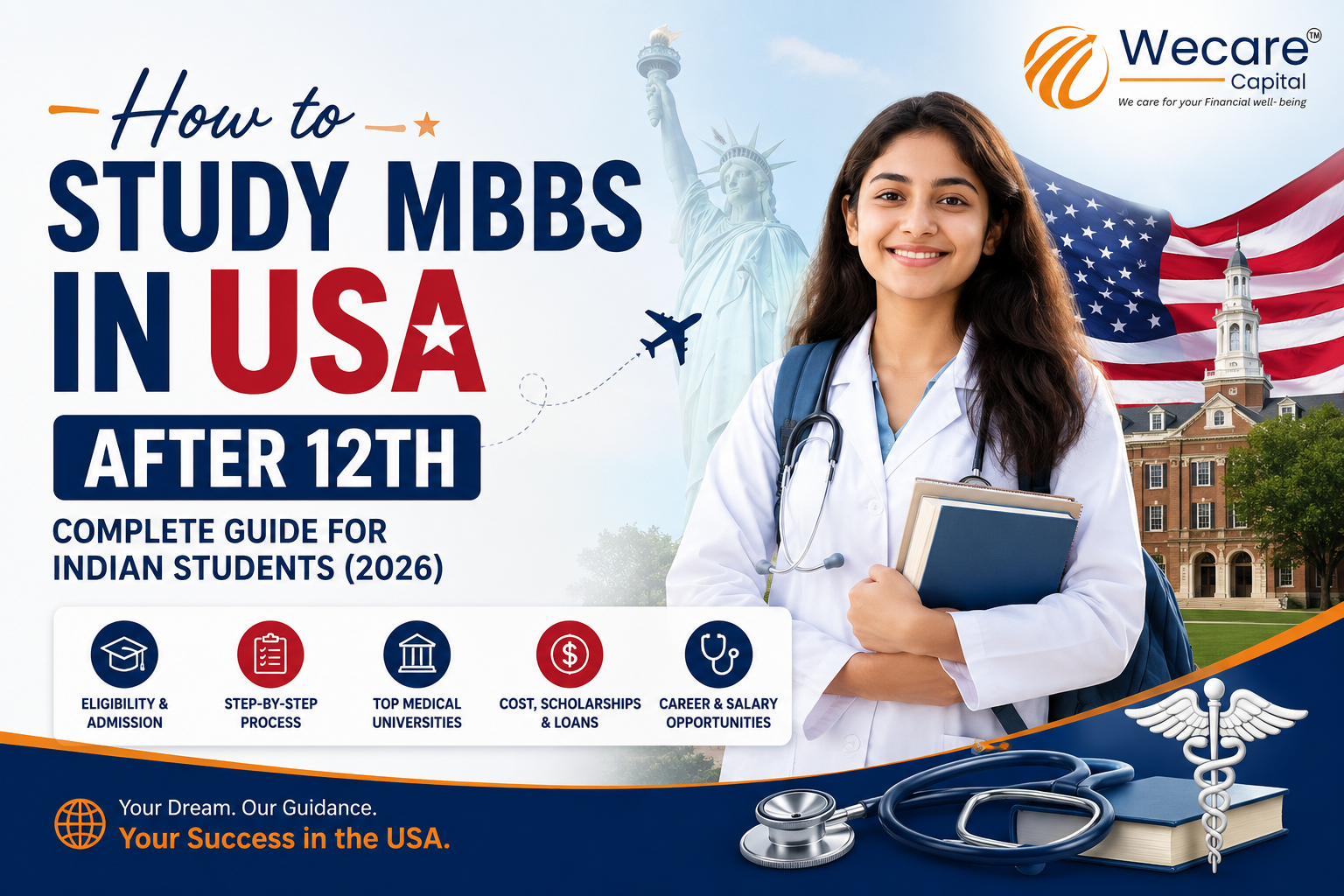
If you’ve been searching for how to study MBBS in USA after 12th, there’s one thing to know first: the USA doesn’t offer a direct MBBS degree. This surprises most Indian students and parents, since MBBS in India is the standard route into medicine right after Class 12. In the US, becoming a doctor works differently, and it takes longer.
That doesn’t mean the dream is out of reach — the path just looks different. This guide walks you through the real pathway, the costs, the top universities, and how Indian students actually fund a US medical education.
No. American universities don’t run an undergraduate MBBS program. Instead, medicine in the US is a graduate-entry degree called the Doctor of Medicine (MD). So while an Indian student wondering “is MBBS available in USA” might feel discouraged at first, the reality is simply that the US uses a different, more research-driven route to the same profession.
Here’s the core difference between MBBS and MD in USA:
| Feature | MBBS (India/UK-style) | MD (USA) |
|---|---|---|
| Entry point | Directly after Class 12 | After a 4-year Bachelor’s degree |
| Total duration | 5.5 years (incl. internship) | 8 years (4-year Bachelor’s + 4-year MD) |
| Entrance exam | NEET | MCAT |
| Degree type | Undergraduate | Graduate/professional degree |
| Licensing exam | None (India) | USMLE |
So when people search for “MBBS in USA for Indian students,” what they’re really looking for is the MD pathway — a longer, more structured route, but one that leads to one of the most respected medical qualifications in the world.
Every doctor in the US, including international students, follows the same core sequence.
Here’s what the journey from Class 12 to independent practice actually looks like.
| Stage | What It Involves | Approximate Duration |
|---|---|---|
| 1. Class 12 | Complete high school with strong grades in Biology, Chemistry, Physics, and English | — |
| 2. Bachelor’s Degree (Pre-Med) | A 4-year undergraduate degree, often in Biology, Chemistry, or a related science, with pre-med coursework | 4 years |
| 3. MCAT | Standardized medical school entrance exam | 3–6 months of preparation |
| 4. Medical School (MD) | Full-time Doctor of Medicine program | 4 years |
| 5. USMLE Step 1 & Step 2 CK | Licensing exams taken during medical school | Alongside MD studies |
| 6. Residency Match | Specialty training under supervision in a teaching hospital | 3–7 years, depending on specialty |
| 7. USMLE Step 3 | Final licensing exam, usually taken in residency | During residency |
| 8. Medical License | State licensure to practice independently | — |
Put together, the realistic timeline from Class 12 to becoming a fully licensed, independently practicing physician in the US is roughly 11 to 15 years. This is a significant commitment compared to the MBBS route in India, which is why early planning academic and financial matters so much.
The admission process for MBBS (MD) in USA is more holistic than India’s NEET-based system. Universities look at your whole profile, not just one exam score.
A recognized Bachelor’s degree with a strong GPA (most competitive programs expect 3.5+ on a 4.0 scale)
Pre-med coursework: Biology, General and Organic Chemistry, Physics, Biochemistry, and Math/Statistics
Clinical exposure through volunteering, shadowing, or research experience
TOEFL or IELTS scores, since almost all instruction, exams, and clinical work happen in English
The Medical College Admission Test is a computer-based exam with four sections covering biology, chemistry, physics, psychology, and critical reasoning
It runs about 6 hours 15 minutes of testing time with roughly 230 questions, scored on a 472–528 scale
Most competitive MD programs look for scores in the high 510s to low 520s
An F-1 student visa is required for full-time study in the US
You’ll need an I-20 form from your university, proof of funds covering tuition and living costs, and a visa interview at the US consulate
Because international students generally can’t access US federal financial aid, proof of financial support (often through an education loan) is a key part of the visa process
A quick and important note before this table: not every US medical school accepts international applicants, and competition for the ones that do is intense. Always confirm a school’s international-student policy directly on its official website before applying.
| University | Location | Duration | Approx. Tuition (per year) |
|---|---|---|---|
| NYU Grossman School of Medicine | New York, NY | 4 years | Full-tuition scholarship for all admitted students, including international students |
| Cleveland Clinic Lerner College of Medicine | Cleveland, OH | 5 years | Full-tuition scholarship (very limited seats, ~32/year) |
| Harvard Medical School | Boston, MA | 4 years | ~$70,000+ tuition; total cost of attendance often exceeds $115,000 |
| Johns Hopkins University School of Medicine | Baltimore, MD | 4 years | ~$63,000+ |
| Columbia University Vagelos College of P&S | New York, NY | 4 years | ~$68,000+ (generous need-based aid, including for international students) |
| Yale School of Medicine | New Haven, CT | 4 years | ~$63,000+ |
| University of Michigan Medical School | Ann Arbor, MI | 4 years | ~$60,000+ |
| Public Texas medical schools (e.g., UTHealth Houston) | Texas | 4 years | ~$28,500 (in-state) to $41,500 (out-ofstate/international) |
Among medical colleges in USA for Indian students, public schools in states like Texas are often more affordable, while a handful of private schools such as NYU and Cleveland Clinic Lerner now offer full-tuition scholarships regardless of residency — though acceptance rates at these schools are typically below 3%.
Understanding the true cost of MBBS in USA (the MD program) means going beyond tuition. Here’s a realistic annual breakdown for an international student at a mid-to-high cost private medical school.
| Expense Head | Approx. Annual Cost (USD) |
|---|---|
| Tuition & fees | $55,000 – $70,000 |
| Living expenses (rent, utilities) | $15,000 – $22,000 |
| Food | $4,000 – $6,000 |
| Health insurance | $3,000 – $4,500 |
| Books & equipment | $2,000 – $3,500 |
| Travel (local + occasional trips home) | $2,000 – $3,000 |
| Total estimated annual cost | $81,000 – $109,000 |
Over a 4-year MD program, this adds up to roughly $325,000 to $435,000, excluding the cost of the undergraduate Pre-Med degree that comes before it. This is precisely why the cost of MBBS in USA is one of the biggest factors Indian families weigh before committing to this path — and why most students combine savings, partial scholarships, and an education loan for MBBS in USA to fund the full journey.
Scholarships for medical students in USA exist, but they’re limited and highly competitive for non-residents:
Institutional scholarships: NYU Grossman and Cleveland Clinic Lerner offer full-tuition awards to every admitted student, regardless of nationality
Need-based aid: Schools like Columbia, Johns Hopkins, and Yale extend need-based financial aid to international students, though it rarely covers the entire cost
External and organization-based scholarships: Various foundations offer partial funding for international medical students, though full-ride awards are rare
Pre-med scholarships: Some scholarships apply only to the undergraduate Pre-Med stage, not the MD program itself
Because international students generally cannot access US government aid or federal loans, most Indian families end up funding the gap with a private education loan.
Once you clear the USMLE and complete residency, the US healthcare system offers strong long-term career opportunities:
High earning potential: Median physician salary is around $386,000–$400,000 a year, with specialties like orthopedic surgery, cardiology, and anesthesiology often crossing $500,000
Specialization choices: Internal medicine, family medicine, emergency medicine, and pediatrics are common entry points for international medical graduates
Growing demand: Physician shortages in several specialties and regions keep demand for qualified doctors strong
Path to permanent residency: Many graduates move from F-1 to H1-B status during residency, with a longer-term path to a green card
| Advantages | Challenges |
|---|---|
| Globally respected MD degree and training standards | Significantly longer duration (11–15 years) than MBBS in India |
| Strong long-term salary potential | High overall cost, often exceeding ₹2.5–3.5 crore across the full journey |
| Access to advanced research and clinical technology | Limited number of schools accept international applicants |
| Clear licensing pathway (USMLE) recognized across the US | No direct access to US federal financial aid |
| Strong residency and career prospects post-licensing | Intensely competitive admissions and residency match process |
Studying medicine in the US is one of the most rewarding and most demanding academic paths an Indian student can choose. It isn’t a quick five-and-a-half-year MBBS; it’s an 8-year academic commitment followed by years of licensing exams and residency.
But for students willing to put in the time, it opens doors to world-class training, strong earning potential, and a globally respected medical career.
The key to succeeding on this path isn’t just academic preparation. It’s realistic planning for the MCAT, for university selection, and importantly, for the substantial cost involved at every stage.
By now it’s clear that studying medicine in the USA is a major financial commitment, often running into several crores of rupees once you account for the Pre-Med degree, the MD program, living expenses, and exam fees along the way. Very few Indian families can cover this entirely out of pocket, which is exactly why an education loan for MBBS in USA has become a standard part of the planning process for most students.
Wecare Capital helps Indian students secure education loans for studying in the USA, with guidance through every stage of the process from understanding how much you can borrow, to comparing lenders, to preparing the documentation your loan application needs.
Rather than navigating this alone, students working with an experienced loan partner can focus their energy on academics and exam preparation.
If you’re evaluating your options, it’s worth exploring Wecare Capital’s USA Student Loan guide for a detailed look at eligibility criteria, loan options, required documents, interest rates, and the step-by-step application process.
Not directly. The USA doesn’t offer an MBBS degree. Indian students must first complete a 4-year Bachelor’s (Pre-Med) degree, then apply to medical school for the MD program using MCAT scores. It’s a longer route than MBBS in India but leads to an equally respected medical qualification.
Roughly 11 to 15 years from Class 12. This includes a 4-year Bachelor’s degree, 4 years of MD, and 3–7 years of residency training, depending on the chosen specialty. USMLE Steps are completed alongside medical school and residency.
No. NEET is India’s medical entrance exam and isn’t used for US admissions. Instead, US medical schools require the MCAT (Medical College Admission Test), a separate exam testing biology, chemistry, physics, and critical reasoning skills.
Total costs for the 4-year MD program alone typically range from $325,000 to $435,000, depending on the university, covering tuition, living expenses, insurance, and books. This excludes the Pre-Med Bachelor’s degree, which adds several years of additional cost.
Yes. Since international students can’t access US federal aid, most Indian students fund their MD education through private or NBFC education loans. Providers like Wecare Capital help with eligibility checks, documentation, and lender comparison for USA-focused student loans
 Study in France for Indian Students 2027: Cost, Universities & Requirements
September 25, 2026
Study in France for Indian Students 2027: Cost, Universities & Requirements
September 25, 2026
 Study in Finland for Indian Students: Universities, Fees, Courses & Visa Guide 2027
September 18, 2026
Study in Finland for Indian Students: Universities, Fees, Courses & Visa Guide 2027
September 18, 2026
 Education Loan Visa Rejection: Reasons, Solutions & How to Avoid It
September 11, 2026
Education Loan Visa Rejection: Reasons, Solutions & How to Avoid It
September 11, 2026
 HENNGE Global Internship Program 2026 Japan: A Complete Roadmap
September 3, 2026
HENNGE Global Internship Program 2026 Japan: A Complete Roadmap
September 3, 2026
 Study in Japan for Indian Students: Complete Guide 2026
August 29, 2026
Study in Japan for Indian Students: Complete Guide 2026
August 29, 2026