
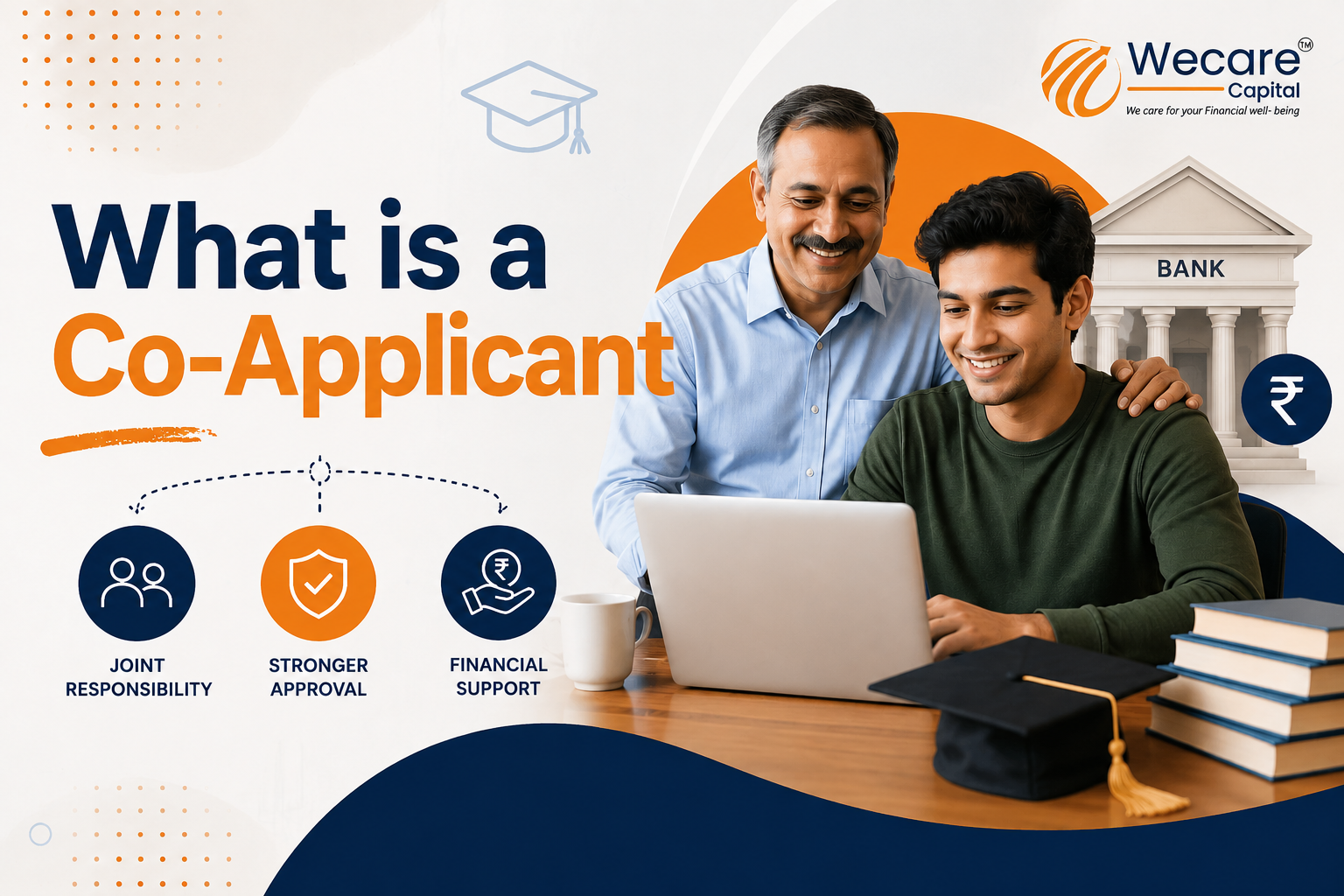
A co-applicant in an education loan is a person, usually a parent, who shares equal legal and financial responsibility for the loan. Most Indian banks and NBFCs require one, especially for loans above ₹4 lakhs. Without a co-applicant, loan approval is difficult unless you have high income or collateral.
If you’ve started filling out an education loan application, there’s a good chance you’ve already stumbled across the term “co-applicant” and felt a little confused about what it actually means. Is it the same as a guarantor? Do you absolutely need one? And who qualifies?
These are questions thousands of students in India ask every year, especially when funding higher education at a reputed college or planning to study abroad. This guide answers all of them in plain language — with real examples, a lender comparison table, and practical advice you can actually use.
A co-applicant in an education loan is a person who applies alongside the student. They are equally responsible for repaying the loan and are legally bound by the terms of the loan agreement from day one.
Think of it this way: banks see students as financial risks, primarily because they have no income at the time of borrowing. The co-applicant steps in as financial backing someone with a stable income and a clean credit history who gives the lender confidence that the loan will be repaid.
Most banks and NBFCs in India mandate a co-applicant, especially when the loan amount is significant.
Yes in the context of education loans in India, the terms co-applicant and co-borrower are used interchangeably. Both refer to the same person who shares equal legal and financial responsibility for the loan.
A guarantor is different. A guarantor steps in only if the primary borrower defaults. A co-applicant is jointly liable from the very first EMI. This is a distinction that students and parents frequently miss and one that has real financial consequences.
Real-Life Example: How Arjun Got His ₹35 Lakh Education Loan
Arjun Sharma, a 22-year-old from Pune, received an admit from the University of Texas at Austin for an MS in Data Science. The total cost tuition, living expenses, and travel came to approximately ₹35 lakhs over two years.
Arjun’s father, Ramesh, worked as a senior software engineer earning ₹82,000 per month with no existing loans and a CIBIL score of 768. He agreed to be Arjun’s co-applicant.
They first approached SBI. While SBI’s interest rate was competitive, the branch required collateral for loans above ₹30 lakhs — which the family didn’t have readily available. They then approached HDFC Credila, which offered a collateral-free education loan of ₹35 lakhs at 11.25% per annum, with Ramesh as the co-applicant based purely on his income and credit profile.
The loan was sanctioned within 12 working days. Repayment starts 6 months after Arjun’s course ends.
What this example shows: The co-applicant’s income, credit score, and existing financial commitments directly determine both the loan amount and the lender options available to you. Arjun’s application succeeded not because of his own profile — he had none but because his father’s financial standing was strong enough to anchor the loan.
Who Can Be a Co-Applicant for an Education Loan?
Not everyone qualifies. Most lenders in India follow specific guidelines. Here is a general breakdown of who can be a co-applicant for an education loan:
Key criteria a co-applicant must typically meet
A student borrowing ₹20–30 lakhs for a postgraduate programme has no income, no significant assets, and often no credit history. From the bank’s perspective, that’s a significant exposure. The co-applicant provides a financial safety net. If the student cannot repay due to unemployment, a health setback, or other reasons, the lender can approach the co-applicant directly for repayment.
Being a co-applicant is not a passive role. It comes with real legal and financial obligations that are often underestimated, especially by parents who sign without reading the fine print.
Key responsibilities include:
The education loan appears on both the student’s and the co-applicant’s credit report the moment it is sanctioned not when repayment begins. Timely repayments build a positive credit history for both. Missed payments hurt both scores equally.
In practice, this has affected parents’ ability to take home loans or car loans during the student’s course tenure. If your co-applicant is planning a major financial decision in the next 2–3 years, factor this in before signing.
| Document Category | Required Documents |
|---|---|
| Identity & Address Proof | PAN Card, Aadhaar Card, Passport, Voter ID |
| Income Proof (Salaried Applicants) | Last 3 Months’ Salary Slips, Form 16 or ITR (Last 2 Years), Bank Statements (Last 6 Months) |
| Income Proof (Self-Employed Applicants) | ITR with Income Computation (Last 2 Years), Audited P&L Statement, Balance Sheet, Business Registration Certificate, GST Certificate |
| Relationship Proof | Birth Certificate, Marriage Certificate, or Any Document Establishing Relationship with the Student |
| Collateral Documents (If Applicable) | Property Papers, Ownership Documents, Encumbrance Certificate, Other Property-Related Documents Required by the Lender |
| Additional Loan Documents | Any lender-specific documents requested during the education loan application process |
Note: The exact documentation requirements may vary across banks and NBFCs. For study abroad education loans, collateral-backed loans generally require additional property-related documents for verification and valuation.
Is table ko blog-friendly format mein is tarah use kar sakte ho:
| Lender | Accepted Co-Applicants | Maximum Loan Without Collateral | Indicative Interest Rate | Study Abroad Loans Available |
|---|---|---|---|---|
| SBI (Scholar Loan) | Parents, Spouse | Up to ₹40 Lakhs (Premier Institutes Only) | 8.15% – 11.15% p.a. | Yes |
| Bank of Baroda | Parents, Spouse, Siblings | Up to ₹40 Lakhs | 8.15% – 10.85% p.a. | Yes |
| HDFC Credila | Parents, Spouse, In-Laws, Siblings | Up to ₹75 Lakhs+ | 10.50% – 13.00% p.a. | Yes |
| Avanse Financial Services | Parents, Spouse, Siblings | Up to ₹75 Lakhs | 10.50% – 14.00% p.a. | Yes |
| Axis Bank | Parents, Spouse | Up to ₹40 Lakhs | 13.70% – 15.20% p.a. | Yes |
| Factor | Public Sector Banks (SBI, Bank of Baroda) | Private Lenders & NBFCs (HDFC Credila, Avanse, Axis Bank) |
|---|---|---|
| Interest Rates | Generally Lower | Generally Higher |
| Co-Applicant Flexibility | Limited | More Flexible |
| Loan Approval Speed | Moderate | Faster |
| Documentation Requirements | More Stringent | Comparatively Flexible |
| Unsecured Loan Amount | Lower | Higher |
| Collateral Requirements | Stricter for Higher Loan Amounts | More Relaxed |
Important Note: Interest rates shown above are indicative and may change based on RBI policy updates, lender guidelines, the student’s university profile, course selection, loan amount, and the co-applicant’s creditworthiness. Always verify the latest rates and eligibility criteria directly with the lender before applying.
Public sector banks such as SBI and Bank of Baroda are usually the preferred choice for borrowers seeking lower interest rates. However, they often have stricter eligibility requirements and may require collateral for larger loan amounts. On the other hand, lenders like HDFC Credila and Avanse offer greater flexibility regarding co-applicant eligibility and unsecured loan limits, making them attractive for students who may not have access to collateral but are willing to pay a higher interest rate.
This is one of the most frequently searched questions and the honest answer is: it depends.
However, education loans without co-applicant options remain limited in India, and interest rates on such products tend to be higher. Our dedicated guide on [Education Loan Without Co-Applicant] and [Education Loan Without Collateral] covers which lenders currently offer these options and under what eligibility conditions.
This situation is more common than most people admit. Here is how to handle it
What Neha did:
1. She checked whether her elder brother (salaried, CIBIL score 742) could be an alternate co-applicant. Her NBFC confirmed siblings were acceptable under certain conditions.
2. They submitted a joint application with her brother as co-applicant and her father as an additional income support document (not a co-applicant).
3. Loan was approved at 12.25%, saving Neha approximately ₹3.8 lakhs in total interest over the loan tenure.
If your preferred co-applicant has a poor credit score, do not immediately accept a high-rate offer. First check whether the lender accepts an alternate co-applicant. Second, request a copy of the co-applicant’s credit report and dispute any incorrect entries sometimes a score can be improved by 40–60 points simply by correcting errors, which can unlock better terms within 30–45 days.
Prioritise a stable, documented income. Lenders examine the co-applicant’s financials carefully. A salaried individual with consistent payslips is generally preferred over someone with irregular self-employment income.
Check their credit score before applying. Pull a free CIBIL or Experian report before submitting any application. A co-applicant with a score below 680 will either reduce your chances of approval or push up your interest rate significantly.
Have an honest repayment conversation. Discuss clearly who will make EMIs during the moratorium period and who takes over after. Setting expectations early avoids conflict later — and financial disputes within families over education loans are far more common than they should be.
Factor in their existing debt obligations. If your co-applicant already has a home loan or personal loan, their debt-to-income ratio may limit the loan amount you can get. Use our [Education Loan Eligibility] guide to estimate this before you apply.
After reviewing hundreds of education loan applications, financial advisors who specialise in student lending consistently highlight one pattern that leads to rejections or poor loan terms: families choose a co-applicant based on convenience rather than financial fit.
The most common mistake is listing the parent who is more emotionally involved as the co-applicant, without checking whether the other parent has a stronger credit profile. In many cases, the second parent — who earns slightly less but has a cleaner credit history and fewer liabilities — would have produced significantly better loan terms.
A few things loan advisors suggest doing before you finalise your co-applicant:
The co-applicant decision is a financial one, not just a family one. Treating it that way from the start produces better outcomes.
Having looked at how education loan applications actually play out across different lender types and student situations, here is what I would suggest based on your specific circumstances:
If both parents are available: Pull both CIBIL scores and compare them. Go with the parent who has the higher score and lower existing liabilities not necessarily the one with the higher income. A clean credit profile often matters more than a slightly larger salary.
If you are planning to study abroad: Start with NBFCs like HDFC Credila or Avanse before approaching public sector banks. They are more flexible on co-applicant types, process applications faster for overseas courses, and do not always require collateral for amounts under ₹50–60 lakhs provided the co-applicant’s income is strong.
If your parents have a low credit score: Do not give up on the co-applicant route. Check whether a sibling or spouse qualifies with your lender. If not, consider waiting 60–90 days while the co-applicant works on their credit score disputing errors, clearing overdue amounts, and reducing credit utilisation can produce meaningful improvements in a relatively short time.
If you genuinely cannot arrange a co-applicant: Look specifically at Education Loan Without Co-Applicant options from fintech lenders and government schemes. Expect higher interest rates, lower loan amounts, or both but they are a real option for students admitted to strong institutions.
One thing I would always do regardless of which route you take: Get the sanction letter before you pay your university seat deposit. Do not assume approval will follow automatically once you have your admit letter in hand. Start the loan process at least 8–10 weeks before your fee payment deadline.
Understanding the co-applicant’s role in an education loan is not just paperwork it is one of the most consequential financial decisions your family will make during the loan process. Choose the right person, check their credit profile in advance, and have a clear repayment plan before you sign anything.
For students who find the co-applicant requirement challenging, there are real alternatives to explore. Our guides on loan options without a co-applicant and Education Loan Without Collateral walk you through current lender options, and our Education Loan Eligibility tool can help you understand what different co-applicant profiles qualify for before you apply.
Planning to fund international studies? Our Study Abroad Education Loan guide covers everything from GRE score requirements to lender shortlisting, and our Education Loan Documents Required checklist ensures you go into your bank visit fully prepared.
Ready to take the next step? Start your application at least 8–10 weeks before your fee deadline and go in with the right co-applicant by your side.
No. Most banks in India restrict the co-applicant role to blood relatives or a spouse. Parents, siblings, and in some cases in-laws are the most widely accepted co-applicants. Friends are not eligible under any mainstream lender’s policy.
Generally, it is difficult. Removing a co-applicant requires either full repayment of the loan or a formal loan restructuring with a new co-applicant. Lenders may consider it case by case if the student has established a strong income and credit history post-graduation.
Yes, in most cases. Lenders require verifiable income — either salaried or from a documented business. A retired parent or homemaker may not qualify unless the loan is structured with adequate collateral.
The bank typically approaches the student or the legal heirs of the co-applicant for repayment. Some lenders now bundle loan protection insurance with education loans — always ask about this option before signing. It adds a small premium but provides meaningful security.
Some banks permit NRI co-applicants, particularly for study abroad loans. Documentation requirements are more stringent, and not all lenders offer this flexibility. Confirm directly with your lender before proceeding.
Disclaimer: Interest rates, lender policies, and eligibility criteria mentioned in this article are indicative and subject to change. Always verify current terms directly with the lender before making financial decisions. This article is for informational purposes only and does not constitute financial or legal advice.
 Study in France for Indian Students 2027: Cost, Universities & Requirements
September 25, 2026
Study in France for Indian Students 2027: Cost, Universities & Requirements
September 25, 2026
 Study in Finland for Indian Students: Universities, Fees, Courses & Visa Guide 2027
September 18, 2026
Study in Finland for Indian Students: Universities, Fees, Courses & Visa Guide 2027
September 18, 2026
 Education Loan Visa Rejection: Reasons, Solutions & How to Avoid It
September 11, 2026
Education Loan Visa Rejection: Reasons, Solutions & How to Avoid It
September 11, 2026
 HENNGE Global Internship Program 2026 Japan: A Complete Roadmap
September 3, 2026
HENNGE Global Internship Program 2026 Japan: A Complete Roadmap
September 3, 2026
 Study in Japan for Indian Students: Complete Guide 2026
August 29, 2026
Study in Japan for Indian Students: Complete Guide 2026
August 29, 2026